 AdvantAce
Film one stroke
Up to 20 seconds — 2–3 reps are enough. Place your phone to the side or rear-side, around waist height. Add a quick caption if something hurts or feels off.
Film your forehand, serve, or backhand on your phone and send up to 20 seconds in Telegram. AI breaks down what's holding the stroke back — factoring in your level and injuries — gives you a drill for your next session, and a coach reviews the clip to add their own take.
Free during open beta · No sign-up required
Filming yourself on court is easy. Knowing what actually needs fixing is the hard part.
You watch your footage and everything looks fine — yet the ball still sails long or hits the net.
YouTube tips are built for someone else's stroke — different grip, different ball speed, and none of your shoulder or elbow limits.
After a month of practice, you still can't tell whether the stroke improved or the old habit crept back in.
Up to 20 seconds — 2–3 reps are enough. Place your phone to the side or rear-side, around waist height. Add a quick caption if something hurts or feels off.
The bot analyzes your stroke using your player profile, ranks the main issues, and gives you a court drill. Then an experienced coach watches the same clip and adds their comments.
The bot reminds you of your focus before your next session. Send another clip of the same stroke and it will compare against last time so you can see what actually changed.
One stroke at a time — from spotting the flaw on video to locking in the fix at practice.
A 1-minute setup before your first review: experience, dominant hand, one- or two-handed backhand, how often you play, and any shoulder, elbow, or knee discomfort. Drills stay safe for your body.
AI delivers a structured breakdown in about a minute, then an experienced coach watches the clip and adds their own notes. We never pass off AI text as a human coach.
If you've already sent a forehand or serve, the next review checks the exact focus you worked on last time instead of starting from scratch.
If the angle, lighting, or low frame rate hides a detail — like grip on a serve — the bot won't make it up. It tells you honestly and suggests how to film the next clip.
Ask clarifying questions right after the review or message the coach directly. Before your next session, the bot reminds you of one focus — and simplifies the drill if it didn't click.
Forehand, backhand, serve, net play, footwork, and rally. Each keeps its own focus and review history.
Pick a stroke to see what our checklist covers:
Early unit turn, movement to the ball, contact point out in front, kinetic chain from legs to arm, and follow-through.
Starting the backswing after the bounce — contact gets jammed near the body and balls miss into the net or sail long.
10–20 seconds from the side or rear-side at waist height, 2–3 strokes in a row.
Separate checklists for your style: top-hand drive and shoulder coil for two-handed, or free-arm counterweight and extended contact for one-handed.
A passive top hand on a two-hander, or crowding the ball so the elbows stay tucked in.
From the backhand side or rear-side so both the preparation and torso stay in frame.
Starting rhythm, toss path and height, trophy position, leg drive, contact height, and landing into the court.
We never guess grip or racket-face angle from a short clip — we only flag what the video actually shows.
Side or rear full-body view with headroom above you so the top of the toss stays visible.
Ready stance and split step, compact punch without a big backswing, contact out in front, and a firm wrist.
Taking a baseline-sized swing at the net — on a faster ball, the racket arrives late and loses control.
Side or front-side near the net, 3–4 volleys in a row from feeds.
Split-step timing, first step to the ball, small adjustment steps, balance at contact, and recovery to center.
Taking big strides with no adjustment steps — hitting from awkward spacing and falling off balance.
Rear-side view showing your full feet and the space you recover into after the shot.
Stroke sequences on the move, transitions between shots, recovery positioning, and the weakest link in the point.
Each stroke looks fine on its own, but freezing after contact leaves you late for the next ball.
Up to 20 seconds of a live rally from behind the baseline — we review real match movement, not just feeds.
Send up to 20 seconds in Telegram — AI breakdown in a minute, coach feedback to follow.
Reviews are live in Telegram today while we finish the native iOS app — with on-device stroke detection, video cropping, and NTRP tracking. Your full history from the bot moves over with one link.
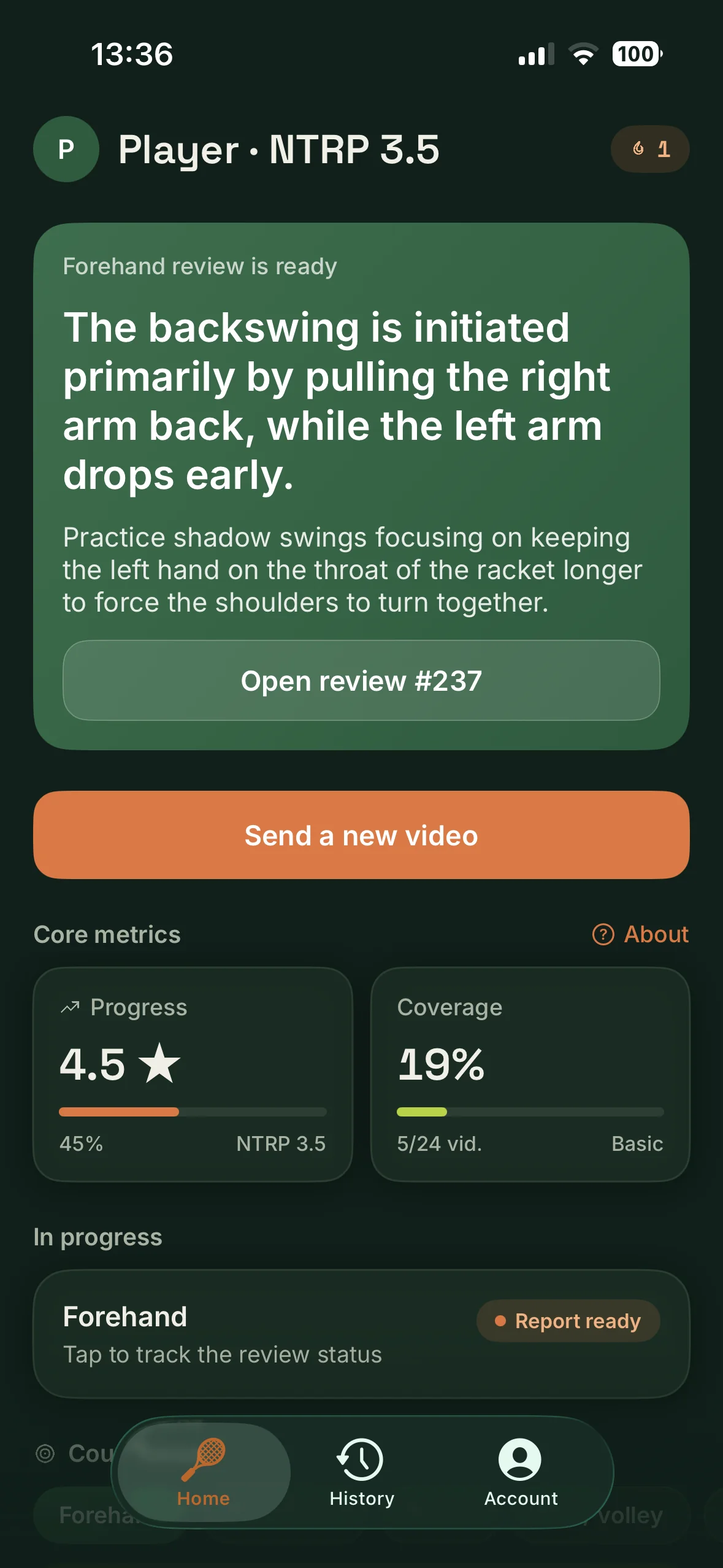
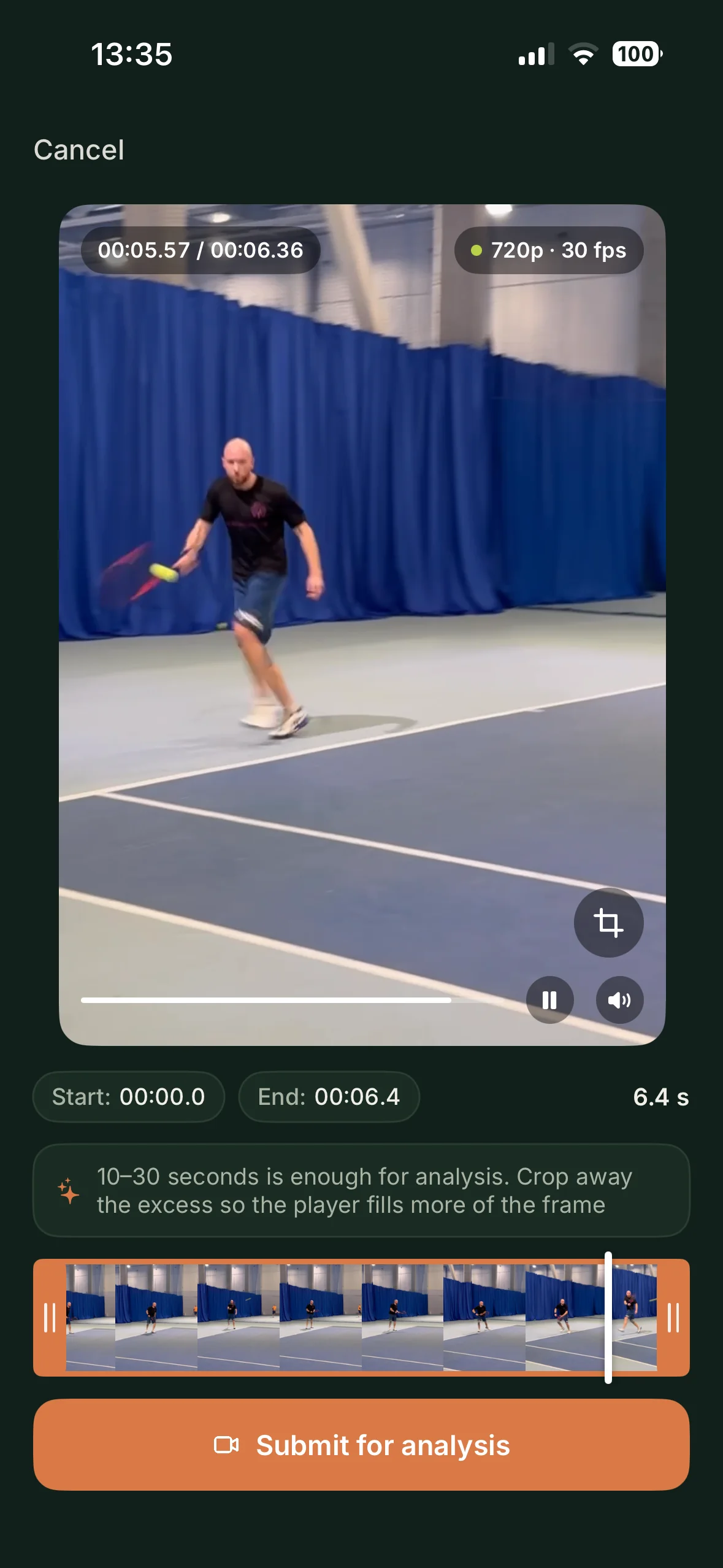
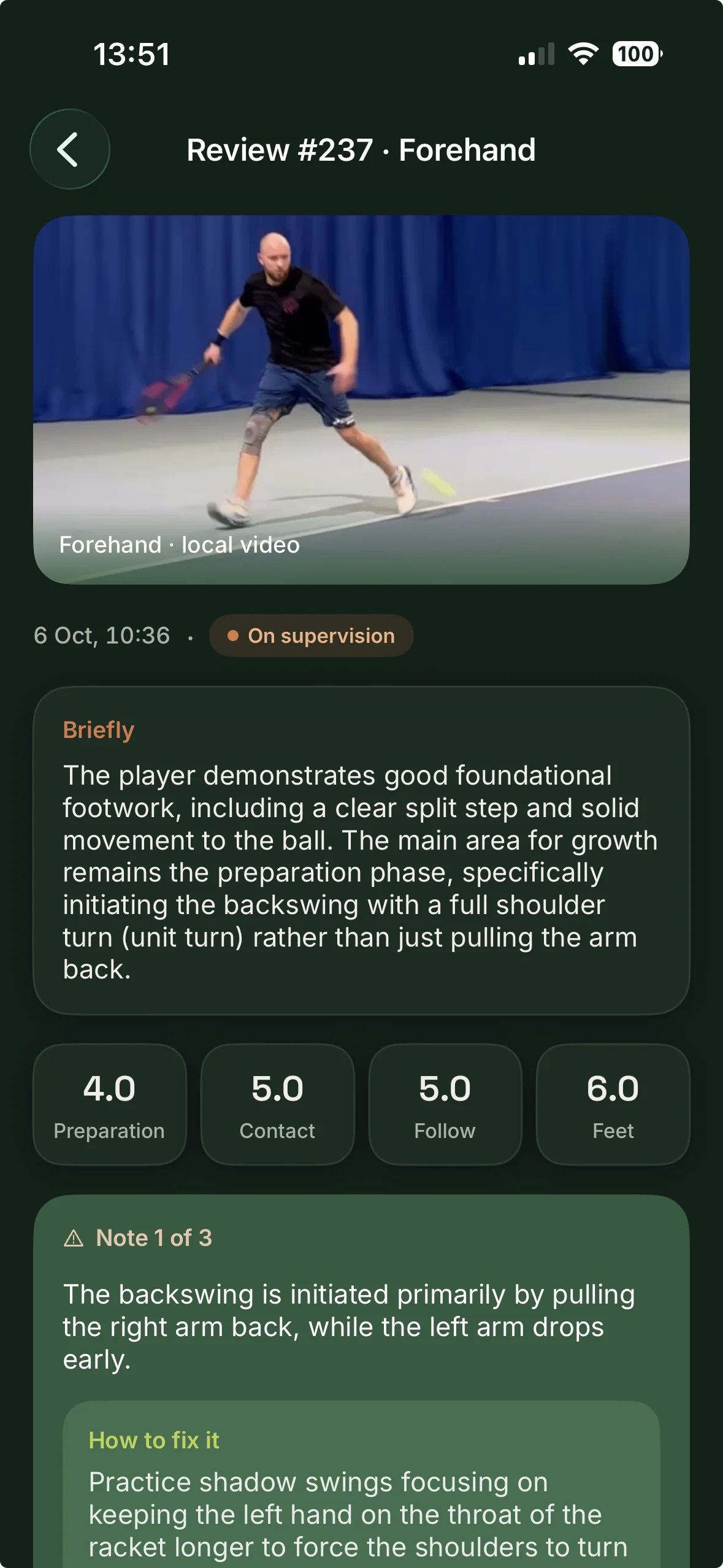
Send up to 20 seconds of one stroke in Telegram — get a technique breakdown, a drill for your next session, and feedback from a coach.
Free during open beta · No sign-up required